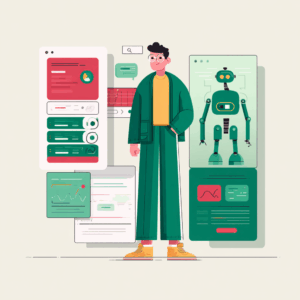
Like many UX’ers, I’ve been leveraging AI tools. And for me, it’s progressed from casual testing to a dependable work partner over the past three years. In fact, I’ve found so much value in it that I went ahead and earned the AI for UX Designers certification from the Interaction Design Foundation (great course, btw!). That combination of practice and study has given me a front-row seat to how these tools are changing design.
What I’ve learned is this: AI isn’t here to replace us—it’s here to accelerate the parts of our work that don’t need a human touch. The result? More time to do the kind of design work that actually moves the needle.
How I use it:
ChatGPT (extensively throughout the day): From “Google-style” questions all the way to deep user research using project mode and Agent workflows.
Figma AI: Great for speeding up layouts and handling the repetitive stuff so I can focus on the bigger picture.
Claude AI: My “vibe coder”—perfect for rapid prototyping and high-level idea exploration.
Midjourney: When I need concept visuals or mood boards that would’ve taken hours before, it now takes minutes.
Miro AI: Brilliant in design thinking workshops for clustering data points (because sticky notes are only fun until you’re drowning in them).
Divi AI: Helpful in the early stages of WordPress site design to quickly explore structure and content direction.
I’m not the only one seeing this. Studies show AI is transforming design workflows:
Boosting efficiency: Tools like ChatGPT significantly improve information retrieval, communication, and decision-making in design briefs and evaluation (Zhu et al., 2024). https://lnkd.in/e9VtmC_i
Helping creativity: Research on designers using AI in ideation found they value it most for gathering data, generating alternatives, and rapid prototyping—while humans still handle judgment, empathy, and ethics (arxiv.org, 2025).
https://lnkd.in/eyBscMhp
Changing the skillset: Another study highlights how designers must now develop a new kind of judgment—knowing when to trust AI, when to push back, and when to throw its output out the window (arxiv.org).
https://lnkd.in/eSZ92wii
Here’s the truth as I see it: AI won’t kill design jobs. But it will kill bad design habits. If your value as a designer is clicking pixels into place all day… AI will do that faster. If your idea of UX research is just asking your mom to try the prototype… AI will outpace you. **But** if you’re focused on empathy, storytelling, strategy, and the messy human side of design—AI will amplify your strengths.
For me, it’s been a magnifier. It magnifies both the good and the bad: strong strategy gets even sharper, weak strategy gets exposed. It’s also an accelerator—iterations move faster, so the need for good judgment becomes even more critical.
I’m curious: How are you using AI in your workflows? Partner, tool, or threat?



0 Comments