From Interviews to Insight: Using AI to Guide Strategy
When I joined the Skyway Industrial Park digital modernization effort under the Presque Isle Industrial Council (PIIC), the mission wasn’t simply to redesign a website. It was to tell a story about possibility — about how a small city in northern Maine could position itself as a hub for innovation, logistics, and sustainable business growth.
But before we could shape that story, we needed to understand the people behind it: the leaders, the decision-makers, and the community stakeholders driving the region’s economic vision.
That’s where research came in — and where AI became a strategic partner in turning human conversations into actionable direction.
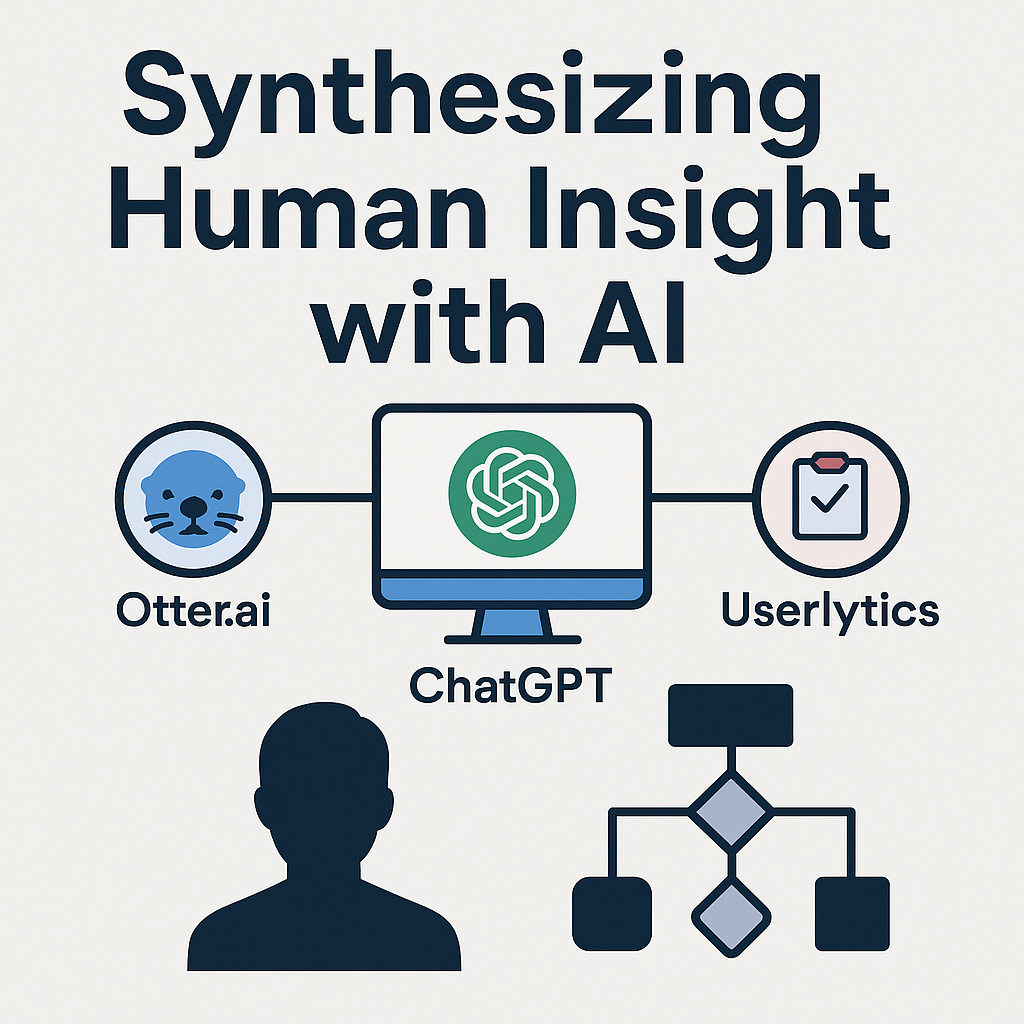
Listening First: The Human Layer (Otter.ai)
I started with deep stakeholder interviews — not surveys, not forms, but real 45-minute conversations with the people responsible for shaping Skyway’s future. These included Tom, PIIC’s Executive Director, and Ruth, the Assistant Executive Director, among others.
The objective was to surface both the explicit goals and implicit drivers:
- What did “growth” really mean for Presque Isle?
- What challenges stood in the way of attracting new tenants to Skyway Industrial Park?
- How could digital presence reflect real-world readiness?
I recorded each session using Otter.ai, which captured every word, pause, and shift in tone. Otter’s transcription accuracy allowed me to stay fully present — listening for patterns and emotional cues rather than focusing on note-taking.
The transcripts became rich qualitative data sets: unfiltered reflections that captured ambition, constraint, and opportunity all in the same breath.
Making Sense of Complexity: ChatGPT Projects + Agent Mode
The next step was synthesis — the part that traditionally takes days or weeks of coding and clustering in Miro or Dovetail.
Instead, I turned to ChatGPT’s Projects feature to create a persistent workspace for all transcripts, notes, and emergent themes. Projects allowed me to maintain context across sessions, while Agent Mode acted as a structured thinking partner.
Here’s how I used it in practice:
- Phase 1: I prompted ChatGPT to summarize each interview in a uniform template — objectives, perceived challenges, recurring language, and emotional tone.
- Phase 2: I asked it to identify cross-stakeholder themes — such as shared aspirations (economic resilience, local talent retention) and friction points (outdated perception of northern Maine, unclear incentives).
- Phase 3: I layered my own interpretation on top, tagging insights by strategic domain: Infrastructure, Business Services, Marketing Narrative, and Community Identity.
By combining human judgment with AI-driven synthesis, I could see patterns emerge almost in real time. The analysis that might have taken two weeks manually was distilled into a few focused sessions — but with greater depth and consistency.
Grounding Strategy in Real User Voices: Qualitative Study
Stakeholder alignment is essential, but validation requires real users.
To test assumptions and ground decisions in lived experience, I conducted a remote qualitative study using Userlytics as a structured interview platform.
Over eight 45-minute video sessions, I met with business owners, regional entrepreneurs, and site selectors who fit Skyway’s target profiles. The goal: to understand how outsiders perceive Presque Isle’s readiness for investment and what they expect from an industrial development site online.
Key learnings included:
- Decision confidence hinged less on raw data and more on narrative clarity — people wanted to feel that Skyway represented opportunity, not risk.
- Users sought quick validation of essentials: land readiness, transportation routes, and business resources.
- The phrase “industrial park” evoked old-world imagery; users responded more favorably when messaging framed Skyway as part of a modern business ecosystem.
These insights became the compass for everything that followed.
From Insight to Action: Strategic Outcomes
Integrating results from Otter, ChatGPT, and Userlytics, I built a cohesive strategy framework for Skyway’s digital presence. It guided not only design and content but also broader economic messaging for the Presque Isle region.
- Content Priorities – Lead with evidence of readiness: transportation access, shovel-ready sites, business resources, and quality of life in northern Maine.
- Narrative Reframing – Shift perception from “available land” to “strategic opportunity.” Skyway isn’t passive real estate; it’s a growth engine for regional development.
- Pain Points Addressed – Simplify access to incentives, clarify documentation, and reduce the cognitive load of navigating city or state programs.
- Experience Design Direction – Move toward a modular, story-driven interface where content can evolve alongside new tenant success stories, reinforcing economic vitality.
The synthesis allowed the Presque Isle Industrial Council to move forward with confidence — aligning marketing, communications, and development planning under a unified, insight-driven narrative.
What AI Actually Changed
The biggest surprise wasn’t the speed. It was the quality of insight.
AI didn’t replace my research process; it elevated it.
By handling the mechanical side of synthesis — summarizing, clustering, and pattern recognition — I was able to spend more energy on interpretation, strategy, and storytelling.
AI also provided a layer of consistency that’s often missing when multiple analysts touch the same data set. Every summary followed the same structure. Every theme map used the same taxonomy. The result was not just efficiency but coherence — a through-line from raw dialogue to executive-level recommendation.
Reflections: AI as a Partner in Design Thinking
This project reinforced an evolving truth in UX leadership:
AI isn’t a replacement for design thinking — it’s an accelerator of it.
In the early stages of research, AI tools like Otter and ChatGPT can surface hidden connections between what people say and what they mean. Later, they become frameworks for scenario modeling, testing hypotheses, and even crafting content direction based on verified user priorities.
For Skyway Industrial Park, this meant we could confidently recommend a human-centered digital transformation — one grounded in local voice, informed by data, and powered by emerging AI practices that scale without losing empathy.
The Broader Implication
Municipal and civic projects often struggle with resource constraints that make traditional UX research seem out of reach.
But as this project showed, a thoughtful AI-augmented approach can deliver enterprise-grade insight at a fraction of the time and cost — while still keeping people at the center.
The future of UX in public sector modernization isn’t about bigger teams or budgets; it’s about augmenting human intelligence with artificial intelligence to close the gap between vision and execution.
How are you using AI to transform your research and strategy process?
I’d love to hear how others are integrating tools like ChatGPT, Otter.ai, and Userlytics to bridge the space between qualitative data and strategic action.



0 Comments